Amend, Don't Reinterpret: Rand Paul's Birthright Citizenship Resolution
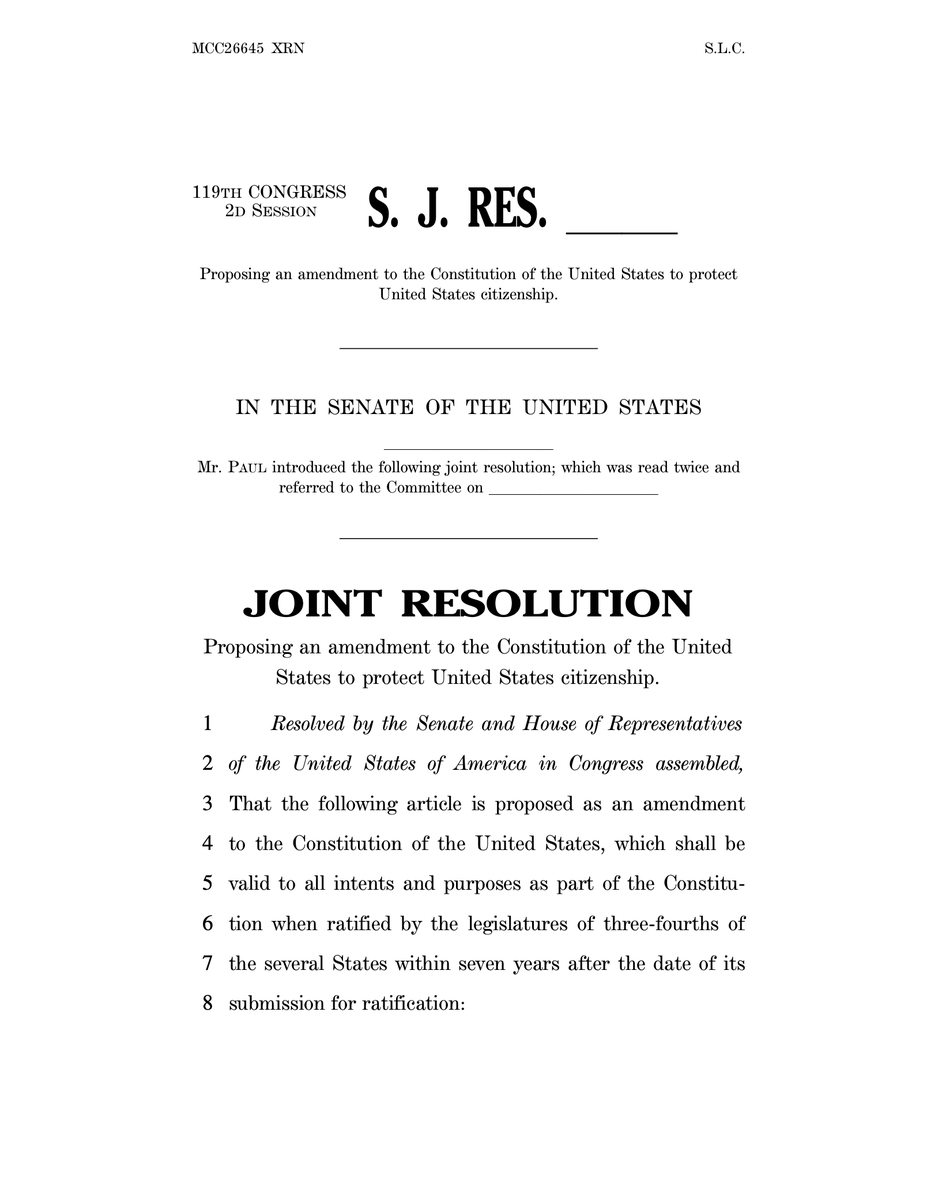
Senator Rand Paul (R-KY) introduced a joint resolution today to amend the Constitution and end automatic birthright citizenship for children of parents with no lawful status in the United States. The text is short, the path is hard, and that is exactly what makes this the right way to fight this fight.
What the resolution actually says
The amendment writes a definition of "subject to the jurisdiction of the United States" — the qualifying clause in the 14th Amendment that has carried this entire debate since United States v. Wong Kim Ark (1898). Under Paul's text, a child born on U.S. soil is "subject to the jurisdiction" only if at least one parent is:
- A citizen or national of the United States,
- A lawful permanent resident actually residing here, or
- A lawful-status alien performing active service in the Armed Forces.
Section 3 gives Congress enforcement power. Seven-year ratification window. Three-fourths of state legislatures required.
He picked the hard path on purpose
The cheap option in 2026 is an executive order or a friendly Supreme Court opinion — both of which evaporate the moment the political wind shifts. Paul went the other way. He filed an Article V amendment. That path requires:
- Two-thirds of the Senate (67 votes)
- Two-thirds of the House (290 votes)
- Three-fourths of state legislatures (38 states)
It is the slowest, most public, most consent-driven way to change the rules in the country. It is also the only path that produces a result the next administration can't undo with a stroke of a pen. Whatever you think of the substance, this is the legitimate door — and the people who want to narrow birthright citizenship for the long haul should be cheering that someone in the Senate is willing to walk through it instead of looking for a shortcut.
The substance: "jurisdiction" was always the key word
Look at the text of the 14th: "All persons born or naturalized in the United States, and subject to the jurisdiction thereof, are citizens." Those last seven words are doing real work. The modern rule — anyone, born anywhere on U.S. soil to anyone, automatic — flows from Wong Kim Ark (1898), a case decided on the facts of a child born to legally domiciled Chinese parents. The doctrine then got stretched, by lower courts and by agency practice, well beyond the case it was built on.
Paul's amendment doesn't argue with the Court. It writes the rule into the supreme law where the Court can't move it.
The carve-outs are reasonable
This isn't a maximalist text. Children of green-card holders still become citizens at birth. Children of lawful-status foreign nationals serving in the U.S. military still become citizens at birth. The only category that loses automatic citizenship is children of parents who had no legal standing to be in the country in the first place — exactly the cohort the original drafters were not trying to enroll, and the cohort whose inclusion turns the immigration system into a gameable incentive structure.
What to do about it
This is the part that matters. A joint resolution dies in committee unless the country moves it.
- Senate cosponsors. Call your senators. Tell them to cosponsor S.J.Res. The number that matters is 67.
- House companion. A House version has to be filed and built to 290. Call your representative.
- State legislatures. Three-fourths means 38 states. Your state senator and state rep have public email addresses. Send a one-paragraph note.
- Seven-year clock. The amendment dies if it doesn't ratify by the deadline. Tempo matters.
Paul did the unfashionable thing — he wrote an amendment instead of a press release. The least the rest of us can do is push it through the door he just opened.
Loading comments...